Showing posts with label solar power. Show all posts

Thursday, August 30, 2012

Green Job Series: Careers in Solar Power [Sixth Installment]

Site assessors, electricians, plumbers, and roofers are also involved in the solar photovoltaic installation process, but are not classified as installers. However, they possess many of the same skills as solar photovoltaic installers and often have work experience in these fields. This installment of The Daily Leap's green job series describes some common jobs in solar panel installation and maintenance.

Occupations in Solar Panel Installation and Maintenance

Site assessors determine how much energy can be harvested at a particular location and then make recommendations based on that assessment. Site assessors help determine the best type, size, and layout of solar panels, and help draw up plans for installation crews. Assessors may take readings of sunlight at a proposed location, review weather patterns, and calculate potential costs and savings.

Site assessors are usually hired for commercial projects by companies that are making substantial investments in solar power and therefore want to ensure maximum benefits from the project. Some site assessors may consult with homeowners or solar installation companies on residential projects.


Electricians install and maintain all of the electrical and power systems in a home or business. They install and maintain the wiring and control the equipment through which electricity flows. Electricians are responsible for connecting the solar panels, inverter, and other equipment to a building's power supply. If a new building or house is being constructed with a solar power generating system, electricians may be responsible for installing the solar power system along with the electrical wiring system, or they may be responsible for simply connecting the solar equipment.

Plumbers install solar water heating systems. These systems replace or augment a conventional water heater and must be connected to a house's or building's plumbing. To install these systems, plumbers require specialized training to work with solar water heater equipment.

Roofers install and repair roofs, and they ensure that any cuts or holes made in the roof during the installation of solar panels and mounting racks are properly repaired and sealed. They may also assist with the installation of mounting systems and structural supports.

Education and Training

Site assessors generally have past experience with electrical or roofing work or experience as solar photovoltaic installers. They receive on-the-job training as well as specialized training in the equipment and techniques used to assess a site for a potential solar project. Some formal educational programs are available that teach basic site assessment including how to gauge the feasibility of solar generation, estimate costs, and determine which products to use.

Electricians and plumbers receive training through supervised apprenticeships administered by technical schools or community colleges. Apprenticeships usually consist of 4 or 5 years of paid on-the-job training and at least 144 hours of related classroom instruction per year. Most states require electricians and plumbers to be licensed. Licensing requirements vary, but it is common for states to require between 2 and 5 years of experience, followed by an examination that tests knowledge of trade and local codes. Applicants for apprenticeships must be at least 18 years old and in good physical condition. Drug tests may be required, and most apprenticeship programs ask that applicants have at least a high school diploma or equivalent.

Electricians and plumbers working on solar installation projects must also have specialized training on the systems that they will be installing, or they must work under the supervision of a qualified solar photovoltaic installer. Certification by the North American Board of Certified Energy Practitioners (NABCEP) is required for many jobs, particularly large commercial installations and residential installations.

Roofers typically have on-the-job training and may participate in 3-year apprenticeship program. Many roofers in the solar industry educate themselves through additional training, or they gain experience to become solar photovoltaic installers.

Earnings

The following table shows U.S. Bureau of Labor Statistics data for selected occupations in the Construction of Buildings industry group for May 2010. This industry group includes new residential and nonresidential construction and remodeling. BLS does not publish data for site assessors. The wages shown are median annual wages for the United States as a whole; wages vary by employer and location..


Occupation Median annual wage
Electricians $45,790
Plumbers, pipefitters, and steamfitters $50,550
Roofers $30,290

For more detailed information on solar panel installation and maintenance occupations in the solar power industry, follow the Occupational Outlook Handbook link.

Next week's new green job series: Careers in Recycling

Wednesday, August 29, 2012

Green Job Series: Careers in Solar Power [Fifth Installment]

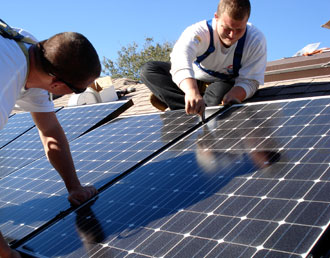
Solar photovoltaic installers are key to the process of solar panel installation and maintenance. They use specialized skills to install residential and commercial solar projects. They are responsible for safely attaching the panels to the roofs of houses or other buildings and ensuring that the systems work. This installment of The Daily Leap's green job series describes the job of a solar photovoltaic installer.

Solar Photovoltaic Installers

Solar photovoltaic installers are often self-employed as general contractors or employed by solar panel manufacturers or installation companies. Self-employed installers typically have training and experience with installing solar power systems and are hired directly by the property owners or by a construction firm.

Job Duties

The main component of a solar installer's job is the preparation of the installation site. Before the installation process begins, a full audit of a structure is conducted, including a survey of the existing electrical system and developing safety procedures. The job is then designed based on the characteristics of the structure and the type of system being installed. After the layout and equipment are finalized, the permits are obtained from the relevant governments (local, state, federal, or a combination). If the installers do not do these preparations themselves, they must familiarize themselves with the site before they begin working on it.

Once installation begins, the proper safety equipment, such as a rope and anchor system, must be set up to prevent falls from the rooftop. Often, the building will have to be upgraded to support the solar panels; this may involve reinforcing the roof, replacing rafters, or installing supports to handle the added weight of the panels. The roof must be marked to show where the arrays will be placed, and holes are drilled in the roof to attach the mounting system. After the mounting system is in place, the solar panels can be installed.

Solar photovoltaic installers must be able to work with power tools and hand tools at great heights, and possess in-depth knowledge of electrical wiring as well as basic math skills. When necessary, installers must be problem solvers, able to repair damaged systems or replace malfunctioning components. Safety is a priority when installing solar panels because installers run the risk of falling from a roof or being electrocuted by high voltage.


Education and Training

Solar photovoltaic installers typically have a background in construction or as electricians. There is no formal training standard for installers, but courses are offered by a variety of institutions, such as trade schools, apprenticeship programs, or by photovoltaic module manufacturers.

Many solar installers are licensed as general contractors and many are licensed by the North American Board of Certified Energy Practitioners (NABCEP). Certification, while not necessary, can improve the job prospects of installers, and many larger projects require workers to be certified.

Solar installers may work alongside roofers, electricians, and plumbers in order to learn the variety of skills needed to complete an installation. Many installers enter the field with previous experience in one or more of these fields.

Earnings

The U.S. Bureau of Labor Statistics does not currently publish wage data available for solar photovoltaic installers, but these data are being collected. According to industry sources, solar installers usually have starting salaries between $30,000 and $40,000 per year. Installers trained as electricians or those that are licensed as general contractors can make significantly more. As with any occupation, wages and benefits vary by employer and geographic location.

For more detailed information on operations occupations in the solar power industry, follow the Occupational Outlook Handbook link.

Tomorrow’s final solar power industry series installment: Other Occupations in Solar Panel Installation and Maintenance

Wednesday, August 15, 2012

Green Jobs Series: Careers in Solar Power

The solar power industry employs a wide range of occupations in a number of major industry segments: research and development, manufacturing of solar power materials, construction of solar power plants, operation of solar power plants, and solar power installation and maintenance. Sales occupations are also integral to the solar power products industry. This installment of The Daily Leap's green job series describes some of the most common jobs in scientific research.

Occupations in Scientific Research

Solar power is still gaining popularity and acceptance, so research and development are key aspects of the industry. Continued research and increased returns to scale as production has increased have led to many developments that have decreased costs while increasing efficiency, reliability, and aesthetics.

Occupations in scientific research and development have become increasingly interdisciplinary, and as a result, it is common for physicists, chemists, materials scientists, and engineers to work together as part of a team. Most scientists in the solar industry work in an office or laboratory and also spend some time in manufacturing facilities with engineers and processing specialists.


Job Duties

Physicists work with chemists, materials scientists, and engineers to improve the efficiency of solar panels. Physicists also find new materials to use for solar panel generation, such as the thin-film photovoltaic solar panels.

Chemists improve on solar cell design, develop new materials for making solar cells, or improve existing materials. They typically focus on semiconducting materials, which are usually silicon-based materials or organic compounds, because most solar panels are made of semiconducting materials and some newer thin-film panels are made out of organic materials.

Materials scientists focus on developing new materials, especially thin-film cells, and decreasing the cost of photovoltaic panels. Materials scientists are also seeking to increase solar panel efficiency. Finally, material scientists are seeking to create building-integrated solar energy technologies that address common complaints about solar panels taking away the aesthetic appeal of a building because of their large and bulky nature.

Education and Training

A doctoral degree is a necessity for scientists that conduct original research and develop new products; however, some workers may enter the scientific fields with a bachelor's or master's degree. Computer skills are essential for scientists to perform data analysis, integration, modeling, and testing. Certification or licensure is not necessary for most of these scientists.

Earnings

The U.S. Bureau of Labor Statistics does not have wage data specific to the solar power industry. The table shows wages for selected scientist occupations for May 2010. The wages shown are median annual wages for the United States as a whole; wages vary by employer and location.


Occupation Median annual wage
Physicists $106,370
Chemists $68,320
Materials scientists $84,720

For more detailed information on scientific research occupations in the solar power industry, follow the Occupational Outlook Handbook link.

Thursday's solar power industry series installment: Occupations in Solar Power Manufacturing